Understanding full grain leather vs genuine leather is the first step toward choosing a gift that lasts. The labels on leather goods can be confusing, and the word “genuine” sounds reassuring even when it describes a lower grade. This guide explains the leather grades in plain language, so you can pick a keepsake worth carrying for years. We make debossed full-grain leather Christian gifts, where a Bible verse is pressed into the hide with a heated metal die — and that craft only works well on honest, high-quality leather, so the difference between grades matters to us, and to you.
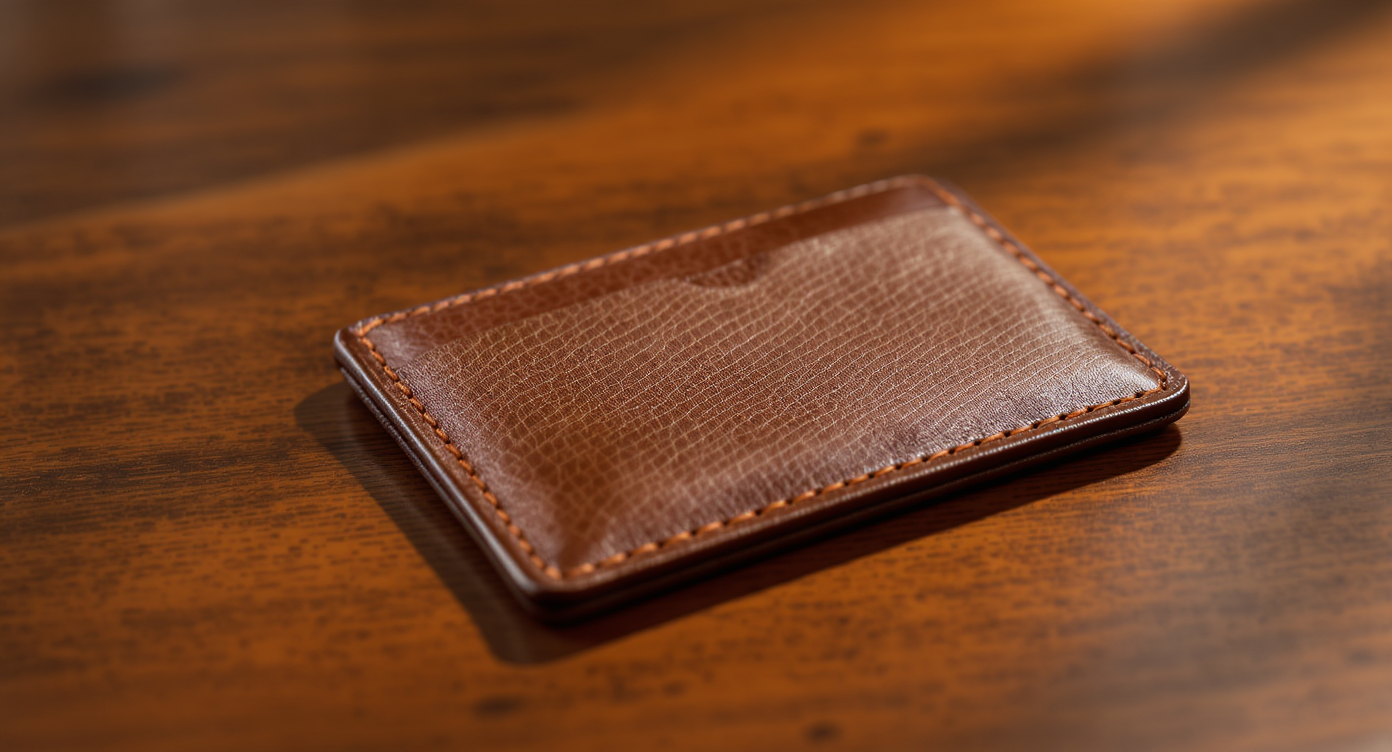
Full grain leather vs genuine leather: the natural grain on the left ages and deepens in a way coated grades never can.
What the leather grades actually mean
Before you can weigh full grain leather vs genuine leather, it helps to know that “leather” is not one material. A single cowhide is thick, so tanneries split it into layers, and each layer is finished differently. The grade tells you which part of the hide you are holding and how much it has been altered before it reaches you.
Knowing these terms turns a confusing shelf of products into an easy decision. Once you can read a grade, the question of full grain leather vs genuine leather answers itself, and marketing words lose their power over you.
Full-grain leather
Full-grain leather is the top layer of the hide with its natural surface left completely intact — nothing sanded away, nothing corrected. You can see the original grain, the tiny pores, and even small marks from the animal’s life, and that is exactly the point: the strongest, tightest fibers of a hide sit at its very surface, so leaving that surface alone preserves both the character and the strength. That is why full-grain is the most durable grade of leather and the one that ages most beautifully, deepening into a personal patina instead of wearing out. It is the leather you find in heirloom belts, fine boots, and saddles that outlast their owners — and the only grade we use for our debossed pieces, because a verse pressed into honest surface fibers stays crisp for decades.
Top-grain leather
Top-grain leather also comes from the upper layer of the hide, but its surface has been lightly sanded and refinished to remove natural imperfections. The result looks uniform and feels smooth, which is why many quality bags and cases use it. It is still good leather — a clear step above the splits sold as “genuine” — but the sanding trades something real away: the strongest fibers live in the very top of the hide, so removing them costs some long-term strength and character, and the refinished face will not develop the same depth of patina as full-grain. If you are weighing the two for an everyday piece, top-grain tends to look cleaner on day one, while full-grain looks better in year five and every year after.
“Genuine leather”
This is the label that fools the most people, because the word sounds like a promise of quality. In practice, “genuine leather” simply means the product contains real leather — often a lower split of the hide, taken from beneath the strong top layers, with a finish or embossed coating applied to make the surface look uniform. It is real leather in the technical sense, but it is usually one of the weakest grades sold as a finished surface: the coating hides weak fibers rather than protecting strong ones, so it scuffs sooner and rarely develops a rich patina. When a price seems surprisingly low for “real leather,” this is almost always the grade in question — fine for a fashion piece replaced next season, but the wrong material for a keepsake.
Bonded and faux leather
Bonded leather is made from shredded leather scraps glued together and pressed onto a backing — it relates to full-grain roughly the way particle board relates to solid wood. Faux leather is not leather at all; it is a plastic coating, usually polyurethane, made to imitate the look of grain. Both can photograph convincingly and both have a place in inexpensive goods, but neither has continuous natural fibers running through it, so both tend to peel, flake, or crack within a few years of regular use — and once that surface goes, there is nothing underneath to restore. For anything meant to be carried daily or kept for years, these are the grades to avoid.
Full grain leather vs genuine leather: the side-by-side comparison
Here is the practical breakdown most buyers want. When you weigh full grain leather vs genuine leather across the factors that matter, the gap is clear.
- Durability: Full-grain keeps the strongest surface fibers and can last decades. Genuine leather, made from a weaker split, wears and scuffs far sooner.
- Look and feel: Full-grain shows natural grain and small marks that prove it is real. Genuine leather often has a printed, plastic-like coating that feels flat.
- Patina over time: Full-grain darkens and softens into a warm, personal sheen with handling. Genuine leather’s coating tends to dull, peel, or stay the same.
- Smell: Full-grain has a rich, natural leather scent. Coated genuine leather can smell faintly of chemicals or plastic.
- Cost: Full-grain costs more because it uses the best part of the hide. Genuine leather is cheaper to produce and price.
- Care: Full-grain rewards simple conditioning and lasts. Genuine leather is harder to restore once the surface coating fails.
How to read a leather label before you buy
Once you start comparing full grain leather vs genuine leather in person, the labels matter less than what your eyes and hands tell you. Marketing copy often leans on warm words like “premium” and “crafted” that say nothing about the actual grade, so judge the leather itself. Look closely at the surface: real full-grain shows natural grain that varies across the piece, with tiny pores and the occasional small mark, while a perfectly uniform, plastic-smooth face is a sign of heavy coating or a lower split. Press gently with a fingertip: full-grain gives slightly and springs back, and over time it creases like skin, where coated genuine leather often feels stiff and recovers with a faint, artificial snap.
Trust your nose, too. Quality leather carries a deep, earthy scent; a strong chemical or plastic smell usually means a coating or a synthetic backing. Read the exact words on the tag — “made with genuine leather” is not a compliment about quality, only a statement that some real leather is present. Finally, ask where on the hide the leather comes from. Sellers proud of full-grain will say so plainly, because it is the part of the story worth telling.
Why patina is the heart of the difference
Patina is the single clearest answer to full grain leather vs genuine leather: it is the soft, deepening sheen that real, uncoated leather earns over time. Oils from your hands, sunlight, and daily use slowly darken full-grain leather and bring out its grain, and no two pieces age the same way — a wallet that rides in a back pocket will deepen at the corners first, while a bookmark that travels in a Bible will darken where fingers turn the pages. Over the years the leather becomes a quiet record of where it has been and who has carried it. Genuine leather usually cannot do this, and that is where the two grades divide most sharply: because its surface is coated or made from a weaker split, it has little natural grain to reveal, and instead of growing richer it tends to fade, scuff through to a lighter layer, or flake. For a keepsake gift meant to be handed down, that difference is everything.
Why full-grain is the right choice for a keepsake
A gift meant to be carried for years should be made from something that gets better with age — in the question of full grain leather vs genuine leather, that is why we use full-grain for our debossed bookmarks, wallets, and keychains. Debossing presses a verse into the surface with a heated die. On full-grain leather the impression is crisp and lasting, and it settles into the patina over the years rather than wearing off the way print on coated leather can. The result is a piece that feels personal the day it is given and more meaningful every year after.
You can see how this works in person on our debossed Bible bookmarks, our everyday leather keychains, and our slim leather card holders. Each one is chosen to age gracefully and travel well.
There is also a practical side to full grain leather vs genuine leather. A keepsake made from full-grain leather rarely needs replacing, so the money you spend goes into something kept rather than something discarded. A lower-grade piece may look similar on day one, but it often shows its age within a season or two. Spending a little more on the right grade is usually the more thoughtful and the more lasting choice.
A few simple care tips
Full-grain leather asks for very little. Keep it out of long, direct heat, wipe away spills promptly, and condition it once or twice a year with a small amount of leather balm. That light routine helps the patina deepen evenly and keeps the debossed verse clear for decades.
For background on how hides are tanned and graded, the overview from the Leather Working Group and the general leather article on Wikipedia are reliable, plain-spoken starting points.
Frequently asked questions
Full grain leather vs genuine leather: is genuine leather real leather?
Yes, genuine leather is real leather, but the name is misleading. It usually refers to a lower split of the hide with a surface coating, which is why it is less durable than full-grain and develops little patina.
Does full-grain leather scratch easily?
Full-grain can pick up light surface marks, but that is part of its charm. Most small scratches blend into the patina or buff out with a little conditioning, and the leather only looks better as it ages.
Which leather is best for a gift that will be used daily?
In full grain leather vs genuine leather, full-grain is the clear choice. It is the strongest grade, it ages beautifully with handling, and a debossed verse stays crisp on its surface, making it ideal for a wallet, keychain, or bookmark carried every day.
A keepsake worth carrying
Now that the choice in full grain leather vs genuine leather is clear, you can give with confidence: choose the grade that grows more personal with every year, and you give something that quietly tells a story. Browse the full collection in our shop, or read more about our craft on the about page. We would be glad to help you find a gift that will be carried, and loved, for a long time.
For the bigger picture, see our overview of full-grain leather — what it is, how it ages, and how to care for it.
Get the verse of the day by email
One King James verse each morning — free, nothing to install. Unsubscribe anytime.
We only use your email for the daily verse. No spam, no sharing.